German Grammar Checker
Loading tool…
About German Grammar Checker
The German Grammar Checker finds spelling, grammar and punctuation mistakes in German text and suggests a fix for each one. It suits learners, students and anyone writing emails or documents in German. It is free, needs no sign-up, checks up to 20,000 characters at a time and supports German from Germany, Austria and Switzerland.
How to check German grammar online
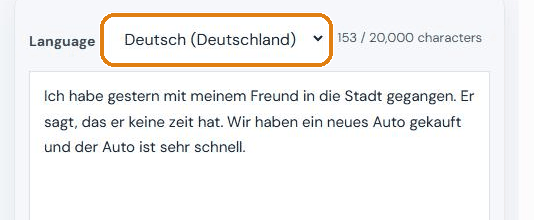
- Choose your variety under "Language": "Deutsch (Deutschland)", "Deutsch (Österreich)" or "Deutsch (Schweiz)". Then paste or type your text. The counter shows how many of the 20,000 characters you have used.
- Click "Check text". The result usually appears within one to two seconds. Each possible mistake is underlined in red.
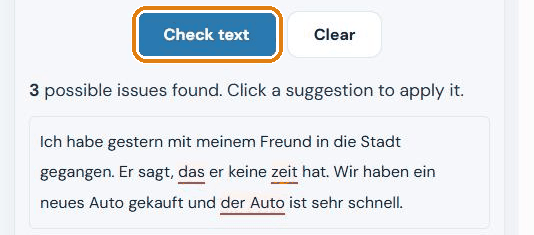
- Read each suggestion. Under the text, every issue shows the word, a short explanation in German and one or more corrections.
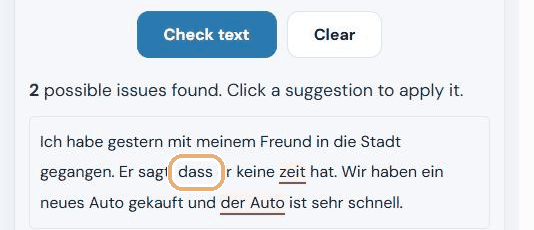
- Click a correction to apply it. The word is replaced in your text and the issue count drops. Repeat until you are happy, then copy your text from the box.
"Clear" empties the box for a new text.
Example: what the checker found in a learner's text
We checked this short text with six typical learner mistakes on 7 October 2026, using "Deutsch (Deutschland)":
Ich habe gestern mit meinem Freund in die Stadt gegangen. Er sagt, das er keine zeit hat, weil er muss arbeiten. Wir haben ein neues Auto gekauft und der Auto ist sehr schnell. Ich freue mich auf dem Wochenende.
| Mistake | Correct German | Found? |
|---|---|---|
| das er keine Zeit hat | dass er keine Zeit hat | Yes: "Meinten Sie „dass“ (Konjunktion)?" |
| keine zeit | keine Zeit | Yes: "Meinten Sie das Nomen „Zeit“?" |
| der Auto | das Auto | Yes: article and noun do not agree |
| Ich habe … gegangen | Ich bin … gegangen | No |
| weil er muss arbeiten | weil er arbeiten muss | No |
| auf dem Wochenende | auf das Wochenende | No |
The checker caught three of six mistakes, all with the right fix. It missed the wrong helper verb, the verb position after "weil" and the case after "freuen auf". Use it as a second pair of eyes, not as proof that a text is correct.
German, Austrian or Swiss German: which should you choose?
| Option | Use it for | What changes |
|---|---|---|
| Deutsch (Deutschland) | Most texts, and anything for readers in Germany | Standard German spelling, including ß after long vowels (Straße, groß) |
| Deutsch (Österreich) | Texts for readers in Austria | Same spelling rules as Germany, with Austrian words accepted: in our test "Jänner" passed, while Deutsch (Deutschland) suggested "Januar" |
| Deutsch (Schweiz) | Texts for readers in Switzerland or Liechtenstein | Swiss German writes ss instead of ß, so "Strasse" is correct |
We tested "Die Strasse ist sehr gross und ich weiss nicht wo das Hotel ist." With Deutsch (Deutschland), the checker flagged Strasse, gross and weiss and suggested Straße, groß and weiß. With Deutsch (Schweiz), it accepted the ss spellings and flagged only the missing comma before "wo".
Common German mistakes the checker helps with
| Error type | Wrong | Right |
|---|---|---|
| das vs dass | Ich glaube, das er kommt. | Ich glaube, dass er kommt. |
| Noun capitals | Ich habe keine zeit. | Ich habe keine Zeit. |
| Article and gender (der, die, das) | der Auto | das Auto |
| ß or ss | Die Strasse ist gross. | Die Straße ist groß. |
| Comma before a subordinate clause | Ich glaube dass er kommt. | Ich glaube, dass er kommt. |
| Typos | das Geschenck | das Geschenk |
Every example in this table was flagged in our tests. German nouns always start with a capital letter, and "dass" (with ss) joins a clause while "das" is an article or pronoun. A comma separates a main clause from a subordinate clause that starts with words such as dass, weil, wenn or wo.
Mistakes to check yourself
Our test showed the checker often misses grammar that depends on meaning: the helper verb in the perfect tense (sein or haben), the verb at the end of a "weil" or "dass" clause, and the case after prepositions such as "auf" or "in". Read these parts of your text again after the check.
German Grammar Checker vs Grammar Checker
Use the German Grammar Checker for German text, and the Grammar Checker for English and other languages.
| German Grammar Checker | Grammar Checker | |
|---|---|---|
| Languages | German only | 24 languages, plus auto-detect |
| German varieties | Germany, Austria and Switzerland | German (Germany) only |
| Text per check | Up to 20,000 characters | Up to 20,000 characters |
| Checking engine | LanguageTool | LanguageTool |
| Best for | Learners and writers working in German, especially Swiss or Austrian texts | English and mixed-language writing |
When to use the German Grammar Checker
- Learning German: check homework, essays and Goethe or telc exam practice texts, then read the explanations.
- Work emails: catch das/dass, capitals and commas before you send a message to a German-speaking colleague.
- Websites and posts: proofread German product pages, social posts and blog articles.
- Swiss and Austrian texts: check spelling against the right variety instead of German rules.
Tips for better results
- Type umlauts and ß properly. On Windows, hold Alt and type 0228 for ä, 0246 for ö, 0252 for ü and 0223 for ß. On a Mac, press Option+U then the vowel for an umlaut, and Option+S for ß. If you write ae, oe or ue instead, the checker flags those words, and its first suggestion can be wrong: in our test "schoen" became "schon" instead of "schön".
- Pick the variety first. Swiss texts checked as German from Germany get flagged for every ss.
- Check in sections. Long texts are easier to review a few paragraphs at a time.
- Do not click every suggestion blindly. Read the explanation, especially for names and technical terms.
- Check again after editing. Fixing one word can change the grammar around it.
Limits, accuracy and privacy
- Length: up to 20,000 characters per check. Longer text shows "Please check up to 20,000 characters at a time."
- Accuracy: it catches most spelling, capital-letter, das/dass, article and comma errors, but can miss meaning-based grammar (see the example above).
- Explanations are in German. They are short, for example "Meinten Sie das Nomen „Zeit“?" (Did you mean the noun "Zeit"?).
- Privacy: checking is powered by the LanguageTool API. Your text goes from your browser to LanguageTool for checking and is not stored by SEO Tools Centre. Don't paste confidential or personal information. See the Privacy Policy.
- Needs a connection: the check runs online, so it will not work offline.
Frequently asked questions
Is the German Grammar Checker free?
Yes. It is free, needs no sign-up and checks up to 20,000 characters at a time, as often as you like.
How can I check German grammar and spelling online?
Paste your text into the box, choose Deutsch (Deutschland), (Österreich) or (Schweiz), and click "Check text". Mistakes are underlined, and you click a suggestion to fix each one.
Does it check Swiss German and Austrian German?
Yes. Choose Deutsch (Schweiz) or Deutsch (Österreich) under "Language". With Swiss German, ss is accepted where German from Germany would use ß.
Can it help me learn German?
Yes, as a checking tool. Each issue comes with a short German explanation, which shows you the rule behind the mistake. It does not replace a teacher, because it misses some grammar that depends on meaning.
Does it check commas?
Yes. In our tests it flagged missing commas before "dass" and before "wo" in an indirect question.
Is my text safe?
Your text is sent to the LanguageTool API for checking and is not stored by SEO Tools Centre. Avoid pasting confidential or personal information into any online checker.
Why does it find no errors in my text?
Either the text is correct or the mistakes depend on meaning, such as the wrong helper verb or case. Read those parts again, and check that you chose the right language variety.
Last updated: