Complex Sentence Generator
Paste your text below, choose its language and click "Generate Complex Sentences". You can then swap any highlighted word for one of the suggestions before you copy the result.

About Complex Sentence Generator
How is sentence 2 linked to sentence 1?
The Complex Sentence Generator joins two simple sentences into one complex sentence, using a linking word such as because, although, after, while, before or if. It suits students, English learners and writers whose text sounds choppy. It is free, needs no sign-up and builds six versions at once, so you pick the one that keeps your meaning.
How to make a complex sentence with the generator
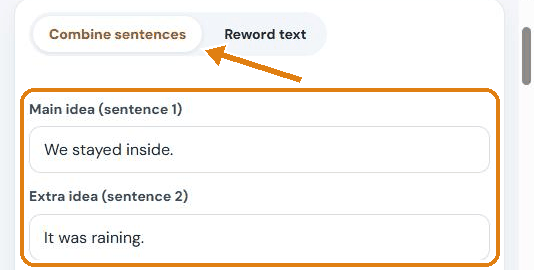
- Open "Combine sentences" (it is the first tab). Type your main idea in "Main idea (sentence 1)" and the extra idea in "Extra idea (sentence 2)". You can also paste both sentences into the first box and the tool splits them.
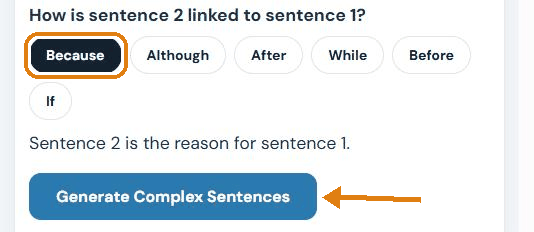
- Choose how the ideas are linked: "Because", "Although", "After", "While", "Before" or "If". The line under the buttons explains each one, for example "Sentence 2 is the reason for sentence 1."
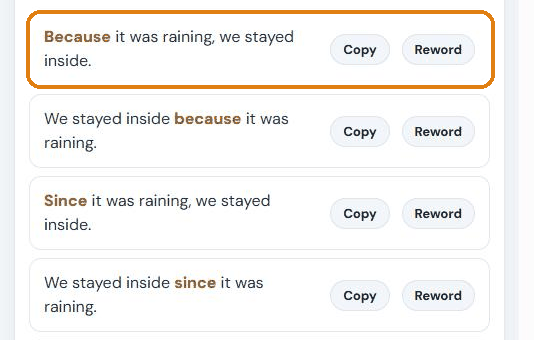
- Click "Generate Complex Sentences". Six sentences appear: each linking word with the dependent clause first and with it second.
- Pick a sentence and click "Copy". The linking word is highlighted so you can see how each version is built. Switch the link type and the list updates straight away.
- Optional: click "Reword" to send the sentence to the "Reword text" tab. Choose "Standard", "Simple", "Formal" or "Fluent", click "Generate Complex Sentences" and review each highlighted word.
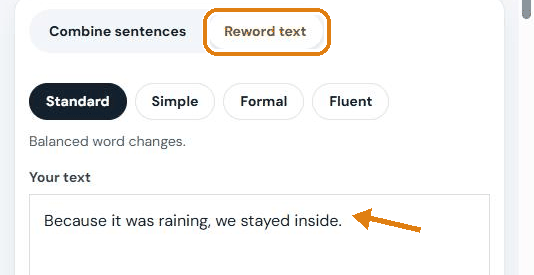
Example: two short sentences, six complex ones
We typed "We stayed inside." and "It was raining." and chose "Because". The tool returned:
| Linking word | Dependent clause first | Dependent clause second |
|---|---|---|
| because | Because it was raining, we stayed inside. | We stayed inside because it was raining. |
| since | Since it was raining, we stayed inside. | We stayed inside since it was raining. |
| as | As it was raining, we stayed inside. | We stayed inside as it was raining. |
All six are correct. "Because" is the clearest. "Since" and "as" can also mean time, so use them only when the reason is obvious. Notice the comma: it appears only when the dependent clause comes first.
Which link type should you choose?
| Button | Use it when | Words it uses | Example |
|---|---|---|---|
| Because | Sentence 2 is the reason | because, since, as | We stayed inside because it was raining. |
| Although | Sentence 2 is surprising next to sentence 1 | although, even though, though | Although the meeting started late, we finished on time. |
| After | Sentence 2 happens first | after, once, as soon as | After I finished my homework, I watched TV. |
| While | Both happen at the same time | while, when, as | The team celebrated when the rover landed. |
| Before | Sentence 1 happens first | before, until | Check the oil before you start the engine. |
| If | Sentence 1 depends on sentence 2 | if, as long as, provided that | If you practise every day, you will improve. |
What is a complex sentence?
A complex sentence is one independent clause joined to at least one dependent clause. The independent clause makes sense alone ("we stayed inside"). The dependent clause cannot stand alone ("because it was raining") and starts with a subordinating conjunction or a relative pronoun.
Simple, compound and complex sentences
- Simple: one independent clause. "It was raining."
- Compound: two independent clauses joined by and, but, or or so. "It was raining, so we stayed inside."
- Complex: an independent clause plus a dependent clause. "Because it was raining, we stayed inside."
A complex sentence shows how two ideas relate (reason, contrast, time or condition), which a pair of short sentences leaves the reader to guess.
The comma rule
Put a comma after the dependent clause when it comes first: "When the bell rang, the students left." When it comes second, you usually need no comma: "The students left when the bell rang." The generator applies this rule for you.
Complex Sentence Generator vs Sentence Rewriter
Use the Complex Sentence Generator to change sentence structure, and the Sentence Rewriter to change the words inside a sentence.
| Complex Sentence Generator | Sentence Rewriter | |
|---|---|---|
| What it changes | Structure: joins two sentences with a linking word | Vocabulary: swaps words for synonyms |
| Input | Two sentences | Any text |
| Output | Six complex sentences to choose from | One reworded text with suggestions per word |
| Meaning | Kept, as long as you pick the right link type | Can shift, so every swap needs a check |
| Where it runs | In your browser; nothing is sent to our server | On our server |
| Best for | Choppy writing, grammar homework, sentence variety | Repetitive wording |
The two work well together. Combine first, then click "Reword" if you also want different words.
When to use the generator
- Grammar practice: check your own answers to "join these sentences" exercises.
- Choppy writing: merge runs of short sentences in essays, emails or reports.
- Sentence variety: mix short and longer sentences so a paragraph reads smoothly.
- Learning English: see how each linking word changes a sentence and where the comma goes.
Tips and common mistakes
- Put the main idea in sentence 1. The tool keeps sentence 1 as the independent clause and makes sentence 2 depend on it.
- Check the direction of time words. "After" means sentence 2 happened first. If the order is wrong, swap the two boxes.
- Do not join unrelated ideas. "Because I like tea, the bus was late" is grammatical but makes no sense.
- Do not overdo it. A page of long sentences is harder to read. Check the result with the Readability Checker.
- Check capital letters on names. The tool lowercases common words such as "it" or "the" when they move inside the sentence, and leaves other words as typed.
Limits, accuracy and privacy
- Two sentences at a time. The tool joins one pair per run. For a longer text, combine the pairs you choose one by one.
- Rule-based, not AI. The tool places your words around the linking word and adds the comma. It does not judge whether the result makes sense, so you choose the version that does.
- English only. Combining works for English sentences. The "Reword text" tab lists other languages, but English gives the best results.
- Privacy: "Combine sentences" runs entirely in your browser. "Reword text" sends your text to the SEO Tools Centre server to look up replacement words. See the Privacy Policy.
- Grammar: the tool does not fix errors already in your sentences. Run the result through the Grammar Checker.
Frequently asked questions
Is the Complex Sentence Generator free?
Yes. It is free, needs no sign-up and works in any modern browser on desktop or mobile.
How do I turn two simple sentences into a complex sentence?
Add a subordinating conjunction to one of them and join it to the other. "It was raining. We stayed inside." becomes "Because it was raining, we stayed inside." The generator does this for you with six linking words.
What words start a complex sentence?
Subordinating conjunctions such as because, although, when, while, after, before, if, unless and since. Relative pronouns such as who, which and that also start a dependent clause.
What is the difference between a compound and a complex sentence?
A compound sentence joins two independent clauses with and, but, or or so. A complex sentence joins an independent clause with a dependent clause that cannot stand alone.
Does a complex sentence always need a comma?
No. Use a comma when the dependent clause comes first. When it comes second, you usually do not need one.
Can I use the generated sentences in my homework?
Yes, for checking and learning. Joining sentences is a grammar skill, so try the exercise yourself first, then compare your answer with the tool's versions.
Last updated: